
Before Cameras, There Was This

In 1432, centuries before photography existed, a Flemish artist painted the reflection of a real window inside a tiny blue gemstone.

The window belonged to the Vijd Chapel, where the finished work would hang. Nearly 600 years later, the illusion is still convincing.
The artist was Jan van Eyck, and the jewel appears in the Ghent Altarpiece, one of the great masterpieces of European art.
Think about when he accomplished this. Gutenberg's printing press was still several years away. Leonardo da Vinci would not be born for another twenty years. The invention of photography lay almost four centuries in the future.

A World Reflected in a Jewel
Begun by Jan's older brother Hubert and completed by Jan, the Ghent Altarpiece consists of a series of panels depicting an elaborate religious vision.
Among them is The Singing Angels. Eight figures gather around a music stand, wearing jeweled crowns and elaborately embroidered robes. Their faces are strikingly individual, with mouths shaped as though producing different notes.
The jewelry and clothing are equally fascinating. Some stones appear translucent, while others catch brilliant reflections. Gold ornaments gleam, and the folds of the robes reveal subtle variations in brightness and shadow.
By depicting the chapel's own window in a blue jewel, Van Eyck created a connection between the scene and the people standing before it. He had considered not only where his work would hang, but also how viewers would experience it.
His understanding went beyond the intricacy of his brushwork. He recognized how profoundly an object's appearance changes according to the way it receives and reflects illumination.

How Do You Paint Something That Shines?
Consider a pearl.
Its characteristic luster comes from delicate variations in brightness across its curved surface, including the soft transitions between shadow and the small highlight that makes it appear luminous.
A transparent gemstone presents another challenge. Rays enter the stone, bend as they pass through and emerge in flashes of color.
Gold reflects its surroundings from an opaque metallic surface. Velvet absorbs and scatters illumination, producing deep, rich shadows, while silk catches it in broad, shifting highlights.
With carefully applied pigments, Van Eyck could reproduce the distinctive qualities of these materials, from the cool hardness of polished stone to the softness of fabric.
But how did he achieve such convincing effects?

The Secret Was in the Paint
Van Eyck brought oil painting, a technique already known in Europe, to new heights. Unlike egg tempera, which dried quickly, oils gave him time to blend colors and work in successive layers.
He applied thin, translucent glazes to enrich hues and create luminosity, adding minute highlights and delicate shading to give objects a three-dimensional quality.
His genius lay in knowing where to place each brushstroke to make gold gleam, silk shimmer and velvet absorb the surrounding light.
Six Centuries Later
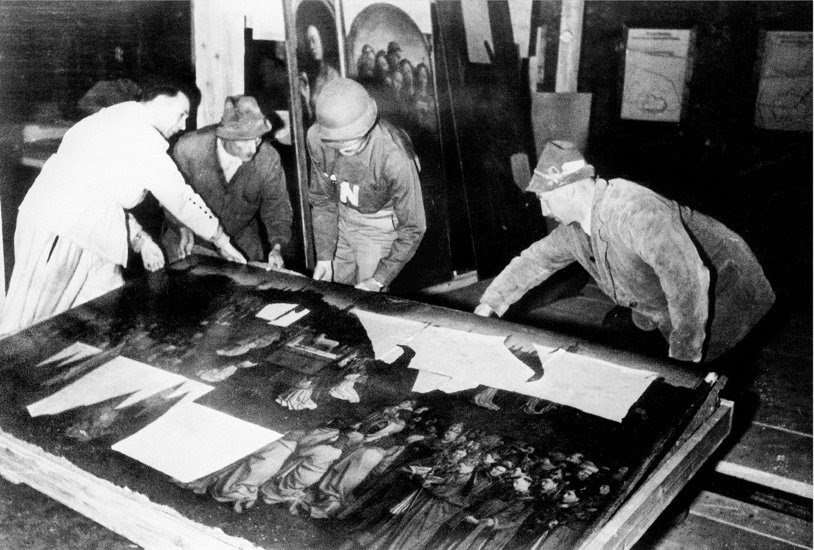
The Ghent Altarpiece has survived war, theft, religious upheaval and repeated restoration.
Since 2012, conservators have used scientific imaging and painstaking techniques to remove discolored varnish and later overpainting, recovering much of the original brilliance of its colors.
High-resolution digital images now allow us to study the work at a scale its earliest viewers could scarcely have imagined. Even the smallest marks of the artist's brush are visible, offering new insight into his methods.
Nearly six centuries ago, daylight streamed through a chapel window in Ghent. The hours passed, the sun moved on, and the shadows shifted.
But in that blue jewel, a moment of daylight remains.

Discover more at VeryCoolFacts.com.
Share with a friend, follow along online, or subscribe for the next edition.
Every visit helps support science, education, health, and the work behind it.


Comments