
It started with a dead frog


You Are Electric
You have a tiny spinning motor inside nearly every cell, powered by electricity, running continuously, right now, as you read this.
Understanding what that actually means took centuries of argument and at least two Nobel Prizes. It started, as you may remember from school, with a frog.
In the 1780s, Italian physician Luigi Galvani was experimenting with electrical current when he noticed that touching a charged metal instrument to a dead frog's leg made it twitch. He called it animal electricity.
He was essentially right. But his rival, Alessandro Volta, argued the electricity came from the metal instruments, not the frog. Volta built the first battery to prove his point and won the argument. Galvani was largely dismissed.
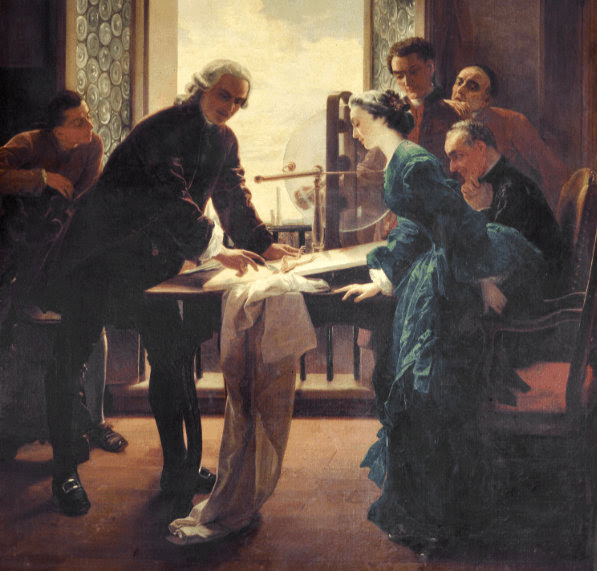
Galvani Luigi Galvani 1737-1798
Making Experiments On Frogs
Assisted By His Wife Lucia Galeazzi
But Galvani's instinct was correct. The body does generate its own electricity. It just took another century and a half, and a very stubborn British biochemist, to prove how.
In 1961 Peter Mitchell proposed that cells produce energy through a voltage difference across the inner membrane of the mitochondria. Charged particles get pumped to one side of that membrane and pile up, creating electrical pressure. The only way back through is a single narrow channel.
As the particles flow through it, drawn by the pressure of the buildup, they spin a tiny molecular rotor the same way water turns a water wheel.
That spinning is what assembles the energy your cells run on. The idea that a living cell was running something resembling an electrical circuit struck most biologists as bizarre. Mitchell was dismissed, argued with, and ignored for years.
He kept working anyway, and in 1978 won the Nobel Prize in Chemistry.

But even that wasn't the whole story. The precise mechanics of the spinning rotor weren't worked out until the 1990s, earning biochemists Paul Boyer and John Walker a Nobel Prize of their own in 1997.
What they found explained something happening inside you right now. Your body contains around 200 types of cells, each with a specific job. Nearly every one of them contains mitochondria, tiny structures that generate electrical energy to keep the cell running.
Neurons are a specialized type of cell whose entire purpose is communication, carrying electrical signals from one part of your body to another. Every thought, every sensation, every memory travels that way. Your mitochondria are the power plants. Your neurons are the telegraph wires.

The medium those signals travel through has a name you already know: electrolytes. Sodium, potassium, calcium, the minerals you lose when you sweat and replace when you drink. In your neurons they rush in and out of the cell in a rapid sequence, triggering each section of the membrane to pass the signal along to the next. Your nervous system runs on them.
We talk about electricity as one of humanity's great discoveries, something we harnessed in the 19th century and built a civilization around. But it was already running inside us. Every glass of water, every pinch of salt, every bead of sweat is part of maintaining an electrical system that has been running for two billion years, long before anyone thought to give it a name.


Curiosity is its own kind of current. Keep following it at VeryCoolFacts.com.
Share with a friend, follow along online, or subscribe for the next edition.
Every visit helps support science, education, health, and the work behind it.


Comments