
Oil, A Royal Banquet in the Desert and the Revolution in Iran

Updated: Apr 20
The End of 2,500 Years of Kings in Iran
Iran's history stretches back more than 2,500 years to the Persian Empire founded by Cyrus the Great.
Over the centuries, Persia became a crossroads of civilization, shaped by empires, trade, and foreign powers. By the early twentieth century, a very different force would transform the region: oil.
This week we take a slightly longer look at Iran’s past. the story includes a remote drilling camp that struck oil for the first time in the Middle East, a lavish royal banquet in the desert in 1971, and the unlikely technology that quietly helped carry a revolutionary across the country.
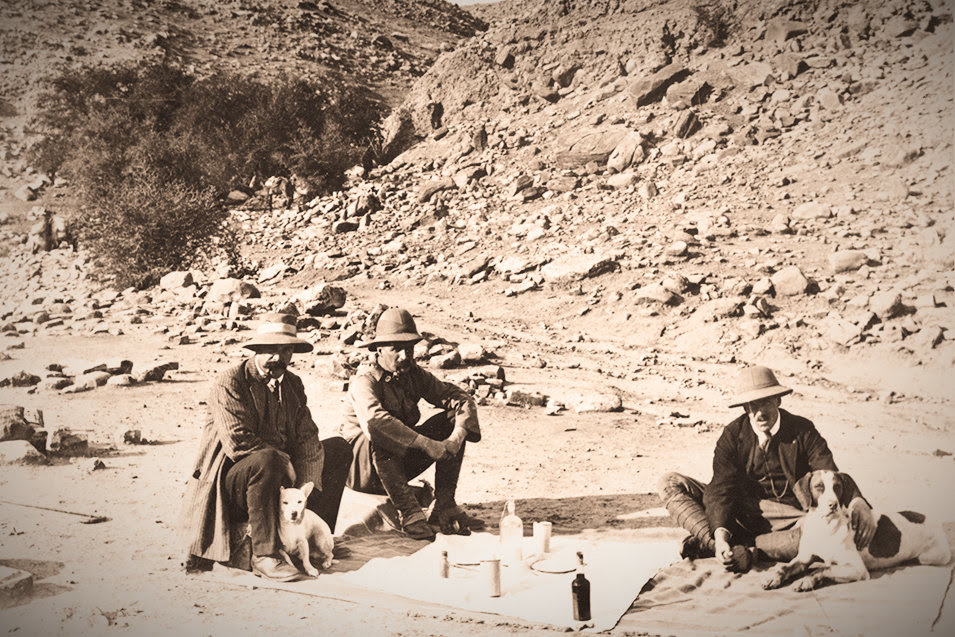
In 1908, a drilling crew working in the rugged hills of southwestern Persia struck the first major oil field in the Middle East. The discovery quickly drew the attention of foreign governments and companies, and Iran’s resources became entangled in global politics for decades to come.
The Empire of Cyrus
In 550 BCE, Cyrus the Great founded the Persian Empire, which would become one of the largest empires of the ancient world.
At its height, the empire stretched from the Mediterranean to Central Asia and included tens of millions of people across three continents.
From cities such as Persepolis, Persian rulers administered a vast and diverse empire through systems of roads, taxation, and regional governors.
Over the centuries that followed, new dynasties rose and fell, but monarchy remained central to Persian political life. By the late eighteenth century, Iran was ruled by the Qajar dynasty, which governed the country from 1789 until 1925, when the Pahlavi dynasty replaced it.
The Rise of a New Dynasty
In 1925 the Iranian parliament deposed the weakened Qajar monarchy and elevated the military leader Reza Khan to the throne.
Taking the name Reza Shah Pahlavi, he founded the Pahlavi dynasty and began a program of centralization and modernization aimed at strengthening the state.
In 1935 he asked foreign governments to use Iran, the country’s historical name, rather than Persia, a name derived from the Greek Persis. The name Iran comes from an ancient word meaning “land of the Aryans,” referring historically to the early Indo-Iranian peoples and languages.
War and a New Shah
During World War II, Britain and the Soviet Union invaded Iran to secure the Persian Corridor, a crucial route used to move Allied weapons, vehicles, and supplies to the Soviet Union.
After the invasion, Britain and the Soviet Union forced Reza Shah to abdicate, amid fears of German influence. His son, Mohammad Reza Shah, was placed on the throne at the age of 21.
The younger Shah would rule Iran for nearly four decades.
Oil Enters the Story
Much of the oil industry was controlled by the British-owned Anglo-Iranian Oil Company (now BP). Many Iranians believed their country was receiving too little benefit from its own natural resources.
In 1951 Prime Minister Mohammad Mossadegh nationalized the oil industry, arguing that Iran should control its own resources and revenues. The decision made him enormously popular inside Iran but provoked a severe confrontation with Britain.
Britain responded with an international boycott of Iranian oil, and the country’s finances deteriorated. Over the next two years tensions grew between Mossadegh and the Shah. Western governments also feared that political instability in Iran could strengthen communist influence during the Cold War.
In August 1953 the Shah attempted to dismiss Mossadegh as prime minister. When the first effort failed, the Shah fled Iran. A few days later pro-monarchy forces succeeded in overthrowing Mossadegh in a coup supported by British and American intelligence services.
The Shah soon returned to Tehran and gradually consolidated far stronger authority.
For many Iranians, the events of 1953 became a lasting symbol of foreign influence in their country’s politics.
The Shah’s Modern Iran
During the 1960s and 1970s the Shah pursued rapid modernization.
In 1971, the Shah hosted an elaborate celebration near the ruins of Persepolis to commemorate what he described as 2,500 years of Persian monarchy, symbolically linking his rule to the legacy of Cyrus the Great.
More than sixty heads of state, royalty, and dignitaries attended the event. A luxury tent city was constructed in the desert to accommodate the guests. The tents were air-conditioned, thousands of trees were planted to create gardens, and about 20,000 songbirds from Europe were brought in to enhance the setting.
The state banquet was catered by the famous Paris restaurant Maxim’s. Chefs and staff traveled from France, and about 18 tons of food were flown in for the occasion. Meals were served on fine porcelain and crystal. The banquet lasted several hours.
Estimates of the celebration’s cost vary widely, but many historians place the cost near 100 million dollars in 1971, an amount equivalent to several hundred million dollars today.
The celebration was intended to showcase Iran’s ancient heritage and modern ambitions. For some critics inside the country, however, the lavish spectacle came to symbolize a widening gap between the monarchy and ordinary citizens.
Yet even as the monarchy staged one of the most lavish celebrations in modern history, opposition to the Shah was quietly growing across Iran.
By the late 1970s, dissatisfaction had spread among students, intellectuals, merchants, and religious leaders.
Much of that opposition would soon find its voice through an unlikely medium: the cassette tape.
The Cleric in Exile
One of the Shah’s most outspoken critics was a cleric named Ayatollah Ruhollah Khomeini.
After condemning the Shah’s policies in the early 1960s, Khomeini was arrested and eventually forced into exile.
From abroad he continued to criticize the monarchy.
In the late 1970s, recordings of his speeches circulated across Iran on cassette tapes, copied and passed from person to person in mosques, homes, taxis, and bazaars.
Long before social media existed, these tapes helped spread a revolutionary message across the country.
A Turning Point
By 1978 protests against the Shah had spread across Iran.
On September 8, large demonstrations gathered in Tehran’s Jaleh Square. Security forces opened fire on the demonstrators, killing and wounding many protesters.
The event became known as Black Friday. It shocked the country and deepened the confrontation between the government and its opponents.
Strikes expanded across Iran in the months that followed, including among workers in the oil industry.
The Revolution That Ended the Monarchy
As protests intensified, the Shah left Iran in January 1979.
Weeks later Ayatollah Khomeini returned from exile to enormous crowds. Within days the monarchy collapsed and the Shah’s government fell, ending a political institution that had shaped Iranian history for more than two millennia.
Iran soon became an Islamic Republic governed by a political system in which religious authority holds central influence.
Iran After the Monarchy
Later in 1979 militants seized the American embassy in Tehran and took dozens of diplomats and staff hostage. The crisis lasted more than a year and led to the severing of diplomatic relations between Iran and the United States.
Today the country is a complex society of nearly ninety million people. Most citizens live in cities, and the country has one of the largest university systems in the Middle East.
Economy
The economy is more diverse than many people assume. Oil and gas remain important but typically account for roughly a quarter of economic activity. Services such as retail trade, transportation, banking, and telecommunications make up the largest share of the economy.
Women
Women represent a significant portion of university students and graduates, particularly in fields such as medicine, science, and engineering. At the same time, women face legal restrictions in certain areas of public life, including limits on some political roles and laws requiring head coverings in public spaces.
Politics
In recent years Iran has also experienced waves of protests over political freedoms, economic conditions, and social restrictions. Some demonstrations have been met with harsh crackdowns by security forces.
Like many countries, Iran is not politically uniform. Some citizens support the current system, others oppose it, and many hold views somewhere in between.
More than four decades after the 1979 revolution, Iran remains a major player in Middle Eastern politics. Its nuclear program and its long and tense relationship with the United States remain major sources of international concern, marked by diplomacy, sanctions, and intermittent military confrontations.
Iran’s modern politics are often explained through the events of the 1979 revolution. Yet the country is also heir to one of the world’s oldest civilizations.
In 1979 the monarchy that had shaped Iran for more than two thousand years disappeared in a matter of weeks.
History rarely moves that quickly.
A Key Moments in Modern Iranian History
550 BCE
Cyrus establishes the Persian Empire
1908
Oil discovered in Iran
1925
Reza Shah Pahlavi seizes power and establishes the Pahlavi monarchy.
1941
Allied forces force Reza Shah to abdicate. His son, Mohammad Reza Shah Pahlavi,
becomes Shah.
1953
A coup removes Prime Minister Mohammad Mossadegh after he nationalizes Iran’s oil.
1963
Cleric Ruhollah Khomeini denounces the Shah’s reforms and is exiled.
1971
Royal Banquet of Persepolis
Jan 1979
The Shah leaves Iran amid mass protests.
Feb 1979
Khomeini returns from exile as the revolution succeeds.
Apr 1979
Iran votes to become the Islamic Republic of Iran.

Thanks for reading Cool Facts Friday.
Discover more surprising stories at VeryCoolFacts.com
Share with a friend, follow along online, or subscribe for the next edition.
And when you do, you are not just learning. Your clicks help support science, education, health, and ideas that make the world better.
The facts only get cooler from here.


Comments