
The $40 Trillion Question

The United States now owes roughly $40 trillion, which is the sort of number that makes $1 million seem like something you might find between the sofa cushions.
$40,000,000,000,000. The zeros are worth displaying because otherwise the word trillion slips past all too easily.
But what exactly is this $40 trillion?
It is the result of decades of borrowing to cover federal deficits. Whenever Washington spends more than it collects, the Treasury borrows the difference. A billion here, a trillion there, year after year, and eventually you arrive at $40 trillion.
The United States has been debt-free exactly once, in 1835, when President Andrew Jackson paid off the entire national debt. The achievement didn’t last long. By 1837, the federal government was borrowing again.

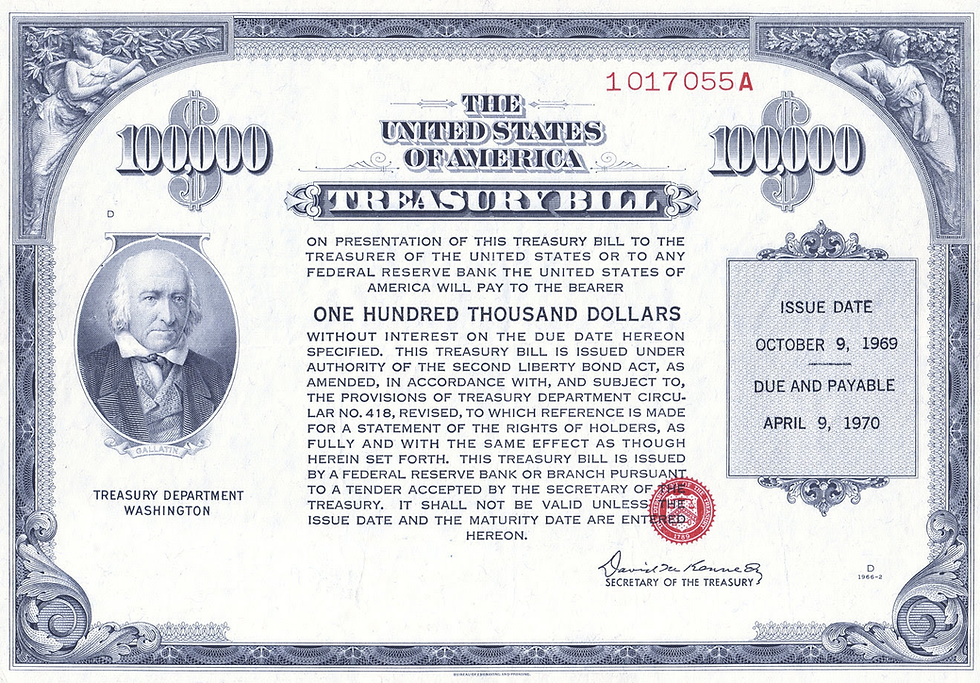
Today, the government borrows by selling Treasury bills, notes and bonds, essentially interest-paying IOUs backed by the United States government. Pension funds buy them. Banks buy them. Mutual funds and individual investors buy them. Foreign governments and investors buy them.
A surprisingly large part of the national debt is therefore money Americans ultimately owe to other Americans.
About $32 trillion of the debt is held outside federal government accounts. Another roughly $8 trillion is owed to the government's own trust funds and accounts. This is called intragovernmental debt.
To understand how the government can owe money to itself, consider Social Security.
For many years, Social Security collected more in payroll taxes than it paid out in benefits, largely because baby boomers were still working while there were far fewer retirees. Those surpluses were invested in special Treasury securities.
Now most baby boomers have retired, reversing much of that arithmetic. Social Security increasingly needs the reserves it accumulated during those surplus years to help pay benefits.
Those reserves aren't unlimited. The fund that pays retirement and survivor benefits is currently projected to exhaust its reserves in 2032. Social Security would continue collecting payroll taxes, but without changes to the system, that income would cover only about 78 percent of scheduled benefits.
Then there is interest.
The federal government is now spending about $1 trillion a year on net interest on the debt, roughly $2.8 billion every day. Even by Washington standards, that's an expensive carrying charge.
Interest has become one of the largest expenses in the federal budget. The government now spends more on net interest than it does on national defense.
And the arithmetic isn't improving.

This year, the federal government is projected to spend roughly $7.4 trillion while collecting about $5.6 trillion. This leaves $1.8 trillion to be found elsewhere.
Most of that difference must be borrowed. That borrowing becomes additional debt, which generates additional interest and another expense in next year's budget.

Source: Congressional Budget Office
Figures rounded. Projected U.S. federal spending, fiscal year 2026
How does America compare?
Several of the world's largest economies carry debts that rival or exceed America's relative to their size. The useful comparison is government debt as a percentage of GDP.
Japan is the heavyweight, with government debt equal to about 204 percent of GDP. Italy and Greece are around 138 and 137 percent, respectively, while France is about 119 percent. U.S. gross government debt is about 126 percent of GDP.
At the other end, Germany's government debt is about 65 percent of GDP. And then there is Liechtenstein, which has managed to remain virtually debt-free.
Debt itself isn't necessarily a sign of fiscal mismanagement. Governments borrow to finance wars and other emergencies, weather economic downturns and fund long-term public investments, including infrastructure.
The problem is that borrowing is no longer reserved for wars, recessions and emergencies. It has become a routine part of paying the bills.
Can governments be protected from their own spending habits? Switzerland and Norway have developed successful, very different approaches to managing public finances, while Australia has taken an unusual approach to funding retirement. See what they do differently →

Discover more at VeryCoolFacts.com.
Share with a friend, follow along online, or subscribe for the next edition.
Every visit helps support science, education, health, and the work behind it.


Comments