
Could We Actually Teach Aging Immune Cells to Act Young Again?

New research suggests that some age-related changes in our immune cells may be reversible.
Every day, microscopic cells move through our bodies, searching for infections, damaged cells, and other threats. They squeeze between the cells lining blood vessels, maneuver through tightly packed tissues, and navigate a maze of fibers that hold our organs together.
These immune cells are extraordinarily agile. They stretch, bend, and change shape to pass through openings narrower than their own diameter. Even their nuclei, which contain their DNA, must sometimes deform to fit.
But as we grow older, some of these cells begin to lose their flexibility, potentially compromising their effectiveness in protecting us from disease.

When Immune Cells Grow Older
In October 2026, researchers at Johns Hopkins University published a study in Nature Communications examining how aging affects T cells, specialized white blood cells that help protect us from disease.
The researchers studied cells from people ages 18 to 93. They found that older T cells could still move, but had more difficulty squeezing through tight spaces and following chemical signals that guide them toward potential threats.
Imagine a security guard who can still patrol the hallways but has increasing difficulty squeezing through narrow passages or following directions.
The researchers wondered whether these changes could be reversed.

An Unusual Experiment
Scientists placed older T cells in a laboratory fluid that was thicker and offered greater resistance to movement.
After seven days, they transferred the cells into a thinner fluid and tested whether the treatment had changed how the cells moved and responded to signals.
The results were surprising. Some older immune cells began behaving more like younger ones, navigating confined spaces and responding more effectively to directional signals.
The improvements lasted for at least a day but were no longer detectable by the fourth day.
For the first time, the researchers had demonstrated that this particular physical treatment could temporarily restore certain youthful characteristics in aging T cells.

Our Cells Have a Sense of Touch
A separate study, published earlier in 2026 by researchers at McGill University, investigated a different way immune cells respond to their physical surroundings.
The scientists placed T cells in collagen gels that mimicked the firmness of different body tissues. They found that stiffer environments encouraged the cells to activate genes associated with developing long-term immune memory.
And the immune system's memory is extraordinary.
After an infection, some immune cells remain in the body for years, sometimes decades, prepared to recognize the same threat if it returns. This biological memory also helps explain how vaccines provide lasting protection.
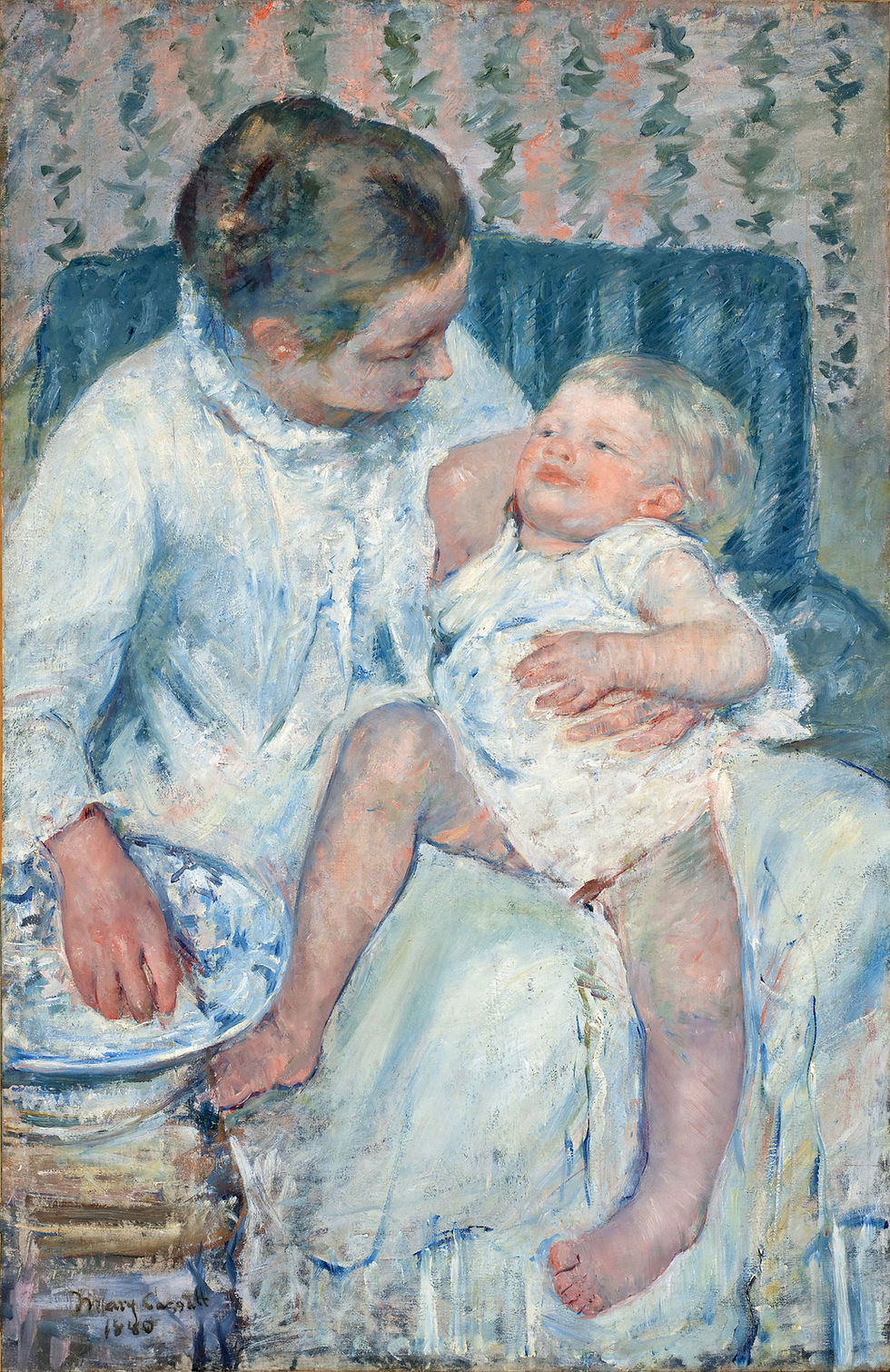
Mother About to Wash Her Sleepy Child by Mary Cassatt, 1880, Los Angeles Coutny Museum of Art
During pregnancy, some of a mother’s living cells, including immune cells, cross the placenta into her baby, where they may remain for decades.
Just how long can the immune system remember?
Scientists studying elderly survivors of the 1918 influenza pandemic discovered some still carried memory B cells capable of recognizing the virus nearly 90 years after their original exposure.
Their immune systems had preserved a biological record of an infection encountered in childhood. Whether the original cells survived or their descendants maintained that memory remains uncertain.

What Could This Mean for Medicine?
As we age, our immune defenses generally become less effective, increasing our vulnerability to infections and weakening our response to some vaccines.
Could restoring the flexibility of aging immune cells eventually improve our defenses?
Cancer treatment offers another possibility.
Some existing therapies involve modifying a patient's immune cells in a laboratory before returning them to attack cancer. Scientists may eventually find ways to improve how those cells move and respond to signals.

Rethinking Aging
For decades, scientists have investigated the chemical and genetic changes that accompany aging. Now they are discovering that the way our cells move and respond to their surroundings may be part of the story, too.
Under certain laboratory conditions, older immune cells can recover some characteristics associated with younger cells.
It raises a question that reaches far beyond the immune system:
How much of what we consider inevitable about aging may eventually prove reversible?

Discover more at VeryCoolFacts.com.
Share with a friend, follow along online, or subscribe for the next edition.
Every visit helps support science, education, health, and the work behind it.
Sources
Dance, Y. W., et al. (2026). Acute priming using elevated fluid viscosity recovers young-like single-cell surveillance behaviors in aged human T cells. Nature Communications, October 15, 2026. https://www.nature.com/articles/s41467-026-78411-1
Postat, J., et al. (2026). Mechanosensing by T cells promotes a tissue-resident memory transcriptional program. Nature Immunology, July 3, 2026. https://www.nature.com/articles/s41590-026-02581-9
Yu, X., et al. (2008). Neutralizing antibodies derived from the B cells of 1918 influenza pandemic survivors. Nature, August 17, 2008. https://www.nature.com/articles/nature07231


Comments