
Planetary Parade Tonight: February 28
What You're Actually Seeing
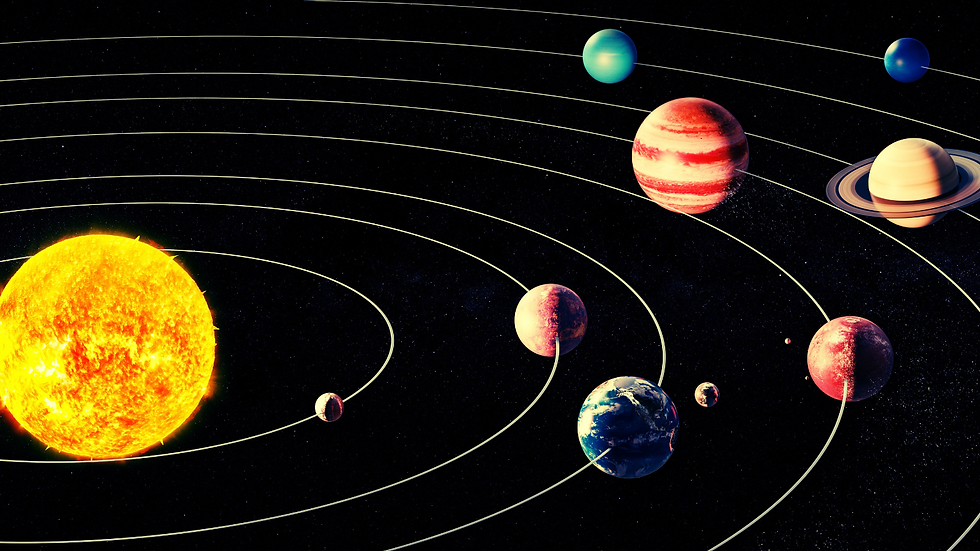
If you step outside after sunset tonight and look low along the western sky, you may spot something quietly extraordinary: four or more planets appearing in a loose sweep across the evening horizon.
This is often called a “planetary parade.” From Earth, several neighboring planets appear strung out along the same sweeping arc of sky, all following the shared orbital plane of our solar system.
All the major planets orbit the Sun in nearly the same flat plane. From our moving vantage point on Earth, that shared plane appears as a curved path across the sky called the ecliptic. When multiple planets happen to be positioned on the same side of the Sun, they become visible along that arc at the same time.
Tonight, look first for the brightest object low in the west after sunset. That is often Venus or Jupiter, both easily visible to the naked eye. Nearby, you may also be able to spot Mars, which typically has a faint reddish tint. Saturn can sometimes be seen as well, though it may appear lower and dimmer depending on its current position.
If you want help identifying what you’re seeing, open the Stellarium app (free version). Allow it to access your location, point your phone at the sky, and it will label the planets in real time. It removes the guesswork and makes the geometry obvious.
A few practical tips:
Go out about 30 to 60 minutes after sunset.
Find a clear view of the western horizon.
Give your eyes several minutes to adjust.
Binoculars can make the dimmer planets easier to detect.
You are watching multiple worlds share the same celestial pathway at once. It is a quiet reminder that we are standing on a moving planet, looking sideways at a solar system in motion.
ADVERTISEMENTS

Compact Binoculars for Adults & Kids
Great for Bird Watching, Concerts & Theater

NASA Lunar Telescope for Kids
90x Magnification, includes Two Eyepieces

FACTS YOU MIGHT BE INTERESTED IN

ARTS & ENTERTAINMENT
The Most Televised Face in History

HISTORY & INNOVATIONS
Hitler's Drug Use: A Documented Medical Record

HISTORY & INNOVATIONS
Why the Middle Finger Is Such an Old Insult

ARTS & ENTERTAINMENT
Homes That Outsmarted the Tax Collector

SCIENCE & NATURE
Why Most Orange Cats Are Boys

SCIENCE & NATURE
Cleopatra’s Breath Might Be in Your Lungs Right Now
ADVERTISEMENT

POPULAR NOW

CURIOUS FACTS
How Retailers Quietly Change Behavior.

HISTORY & INNOVATIONS
The Fish That Fed Empires

CURIOUS FACTS
The Most Interesting Part of the Global Economy Isn't How Big It Is

SCIENCE & NATURE
When Google Used A Camel to Map the Desert

SCIENCE & NATURE
How Ranchers Know When Sheep Have Mated (Without Guessing)

HISTORY & INNOVATIONS
Before it Was Cozy, It Was Controversial
ADVERTISEMENT